 |
The Suez Rift, previously considered inactive, is still experiencing tectonic movement, with the African and Arabian plates drifting apart at 0.26–0.55 mm per year. Geological evidence, including uplifted coral reefs and faulted rock layers, confirms ongoing rifting and crustal uplift. This continued activity suggests seismic hazards remain and informs models of rift evolution.
|
|
 |
Deep waters of the Arctic Ocean, particularly in the Eurasian Basin, are warming at a rate of 0.020 °C per decade, exceeding what geothermal heating can explain. This warming is primarily driven by warmer deep water from the Greenland Basin, which no longer supplies the Arctic with its previous cold water. The Lomonosov Ridge limits this effect to the Eurasian Basin.
|
|
 |
The 2025 earthquake swarm near Santorini was caused by pulses of magma slicing horizontally through the crust at depths greater than 10 km, rather than tectonic fault slip. Advanced seismic analysis revealed that these magma intrusions, linking Santorini and Kolumbo volcanoes, did not reach the surface or trigger an eruption, but generated significant underground stress and seismic activity.
|
|
 |
By 2100, approximately 5,500 hazardous sites in the US are projected to face coastal flooding risk due to sea level rise, with over half threatened as early as 2050. Marginalized communities are disproportionately affected. Moderate emission reductions could lower the number of at-risk sites by about 300. Flooding may increase exposure to toxic substances, posing significant health risks.
|
|
 |
Digitized 1960s aeromagnetic data from the Afar region, combined with other vintage datasets, reveal that magnetic lineations align with the Gulf of Aden and Red Sea rifts rather than forming the expected triple junction pattern. This suggests continental rifting in the area followed a single fracture, refining understanding of how Africa and Arabia began to split apart.
|
|
 |
Implementation of alternating dual-pit latrines in rural Cambodia showed that, despite positive attitudes toward the technology, correct usage was inconsistent. Only 40% of households recalled key maintenance steps, and none waited the recommended two years before emptying pits, increasing health risks. These findings highlight the need for service-based waste management rather than relying on self-management.
|
|
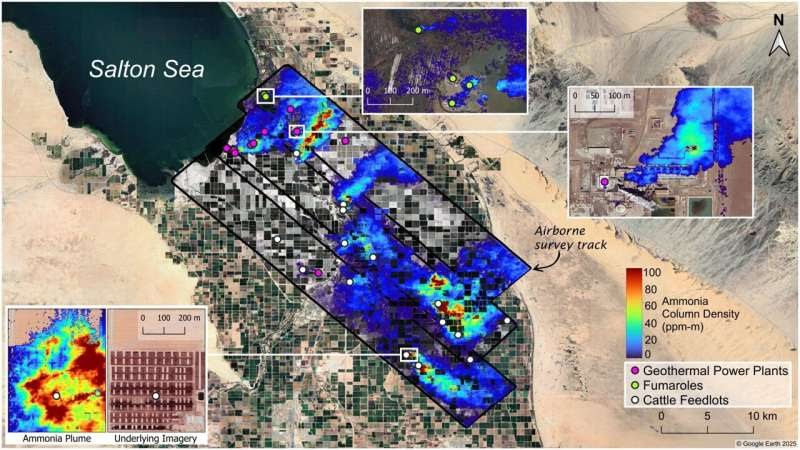 |
Airborne imaging spectrometers mapped ground-level ammonia plumes in California’s Imperial Valley, identifying elevated emissions from agricultural fields, livestock feedlots, and geothermal plants. Ammonia, a precursor to harmful PM2.5 particles, was found at concentrations up to eight times higher than background levels, highlighting the value of high-resolution monitoring for air quality management.
|
|
 |
California landfills have experienced underground fires and methane leaks, releasing hazardous pollutants and greenhouse gases. Proposed state regulations would require faster detection and repair of leaks, use of advanced monitoring technologies, and stricter temperature controls. These measures aim to reduce methane emissions, improve community health, and address safety risks, despite concerns over increased operational costs.
|
|
 |
Bubbles observed off Hermosa Beach were caused by contractors working on an underwater transpacific fiber optic cable. Air was blown through the conduit to ensure it was clear for additional cable installation, resulting in visible bubbles at the surface. The phenomenon was unrelated to marine life or submarines.
|
|
 |
Global climate projections rely on Earth system models that simulate atmospheric, oceanic, and land processes using supercomputers. These models, coordinated through the Coupled Model Intercomparison Project (CMIP), inform international climate assessments and policy. Advances in model resolution, emissions-driven simulations, and regional downscaling enhance the accuracy and relevance of climate risk assessments.
|
|
 |
COP31 will be hosted by Turkey, with Australia presiding over negotiations, while Pacific nations lose the opportunity to co-host. Despite this, Pacific leadership in climate action remains crucial, especially regarding the 1.5 °C target and ocean protection. Australia is expected to ensure Pacific priorities are reflected in COP31 outcomes and maintain strong regional partnerships.
|
|
 |
Coastal wetland restoration efforts often overlook groundwater dynamics, which significantly influence carbon storage and emissions. Subsurface water flows can shift wetlands from carbon sinks to sources by affecting sediment oxygen exposure and microbial activity. Integrating groundwater processes into restoration is essential for accurate carbon accounting and maximizing climate and biodiversity benefits.
|
|
 |
Monsoon storms in South Asia are projected to become weaker but produce significantly more rainfall as global temperatures rise, with up to 28% more rain from the strongest storms at 3°C warming. The frequency of storms is expected to increase by about 15% at 2°C warming, and storms will penetrate further inland, raising flood risks in western India, Sri Lanka, and Bangladesh.
|
|
 |
Cuts to US government weather forecasting and moves toward privatization risk reducing the quality and timeliness of hurricane warnings, especially for vulnerable regions like Puerto Rico. Puerto Rico already faces delayed and less precise forecasts compared to the continental US, compounding its exposure to rapidly intensifying storms and raising concerns about climate justice and equitable access to life-saving information.
|
|
 |
Achieving the Paris Agreement’s temperature targets requires canceling most existing fossil fuel concessions and halting new licenses, alongside major investment in renewables. Oil extraction in the Amazon causes significant pollution and disproportionately affects indigenous communities, with most violations going unpunished. Strengthening environmental monitoring and integrating indigenous oversight are recommended.
|
|
 |
High levels of PFAS contamination in North Carolina’s Piedmont region were traced to a textile plant releasing solid nanoparticle PFAS precursors, which standard tests missed. Wastewater treatment accelerated their conversion to regulated PFAS, leading to widespread environmental contamination. These precursors persist in biosolids used as fertilizer, posing a long-term source of PFAS pollution.
|
|
 |
A new “All Flow Directions” (AFD) scheme enables weather models to represent mountain terrain continuously for any wind direction, reducing errors from traditional eight-direction methods. Testing over the Qinghai-Tibet Plateau showed AFD improves stratospheric wind simulation accuracy by 10–20%, enhancing forecasts in complex terrain and supporting better prediction of weather and climate phenomena.
|
|
 |
Brazil introduced measures requiring participants at COP30 to disclose their funding sources and align with Paris Agreement goals, aiming to counteract the influence of fossil fuel lobbyists and climate misinformation. Despite these efforts, fossil fuel lobbyists remain numerous, highlighting the ongoing challenge of ensuring transparency and integrity in climate negotiations.
|
|


